


Dynamic Metabolic Regulation and Vitamin C-Mediated Inhibition of Vibrio splendidus Persisters by Single-Cell Raman Spectroscopy
- David Ojcius
- 4 hours ago
- 1 min read

Highlights
Single-cell Raman spectroscopy coupled with D2O labeling was first applied to Vibrio splendidus persisters.
V. splendidus persisters are metabolically active rather than fully dormant.
Persisters show remodeled cellular components with decreased nucleic acids and increased lipids and polysaccharides.
Vitamin C inhibits persisters by suppressing the stringent response, providing a green anti-persister approach.
Abstract
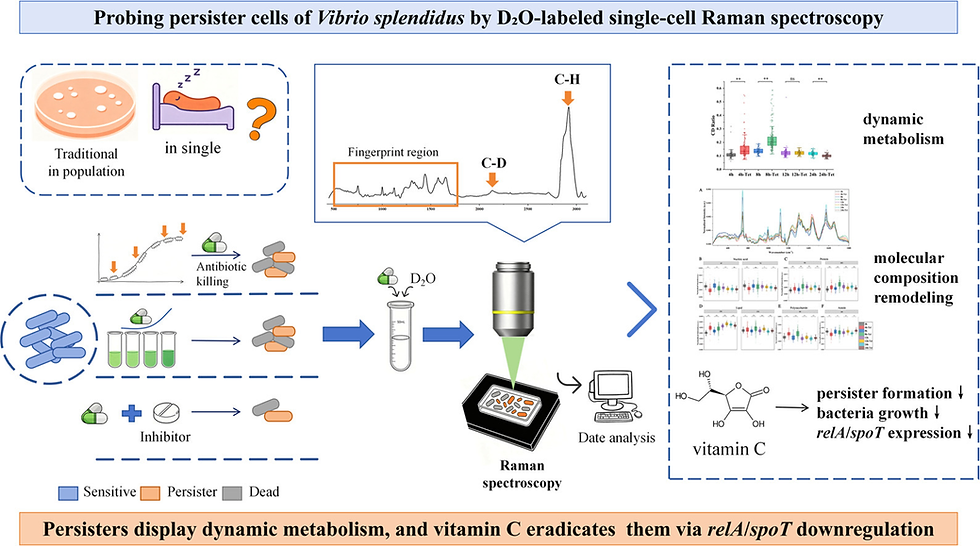
Persister cells, a multidrug-tolerant bacterial subpopulation, pose challenges to disease control, with research hindered by technical limitations. In this study, single-cell Raman spectroscopy (SCRS) combined with heavy water (D2O) labeling was employed to explore the metabolic activity and compositional changes of Vibrio splendidus persisters. Raman analysis revealed distinct biochemical profiles between persisters and normal cells: persisters reduced nucleic acid-related band intensity but increased lipid and polysaccharide-related bands. Using the deuterium incorporation rate as a quantitative indicator of biosynthetic activity, we found that biosynthesis remained active under antibiotic stress during the exponential growth phase, while it declined under identical stress conditions in the stationary phase. It is revealed that persisters are not in a fully dormant state, and diverse metabolic patterns are found among persister cells. Furthermore, our screening results identified vitamin C is a potent inhibitor of persister formation in a concentration-dependent manner, it may be associated with the down-regulation of the stringent response genes relA and spoT. Collectively, this study demonstrates that SCRS combined with D2O labeling is a powerful tool for investigating the physiological characteristics of V. splendidus persisters, and provides metabolic modulation strategies for the control of persistent infection in aquaculture.
Read full article for free (open access):


Comments