


Revealing unexplored bacterial and fungal variability in interconnected Antarctic brines
- David Ojcius
- Dec 18, 2025
- 1 min read

Highlights
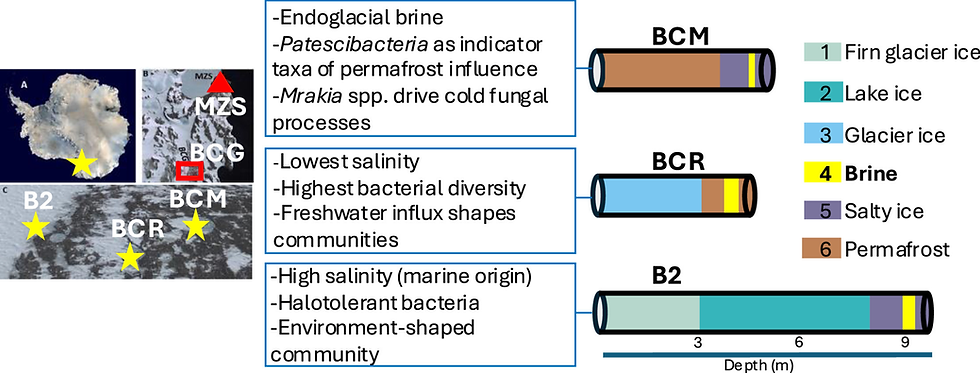
Interconnected Antarctic brines show distinct bacterial and fungal communities
Fine-scale geochemistry and substrate context filter microbial assembly
B2 brine (hypersaline) shows halotolerant bacteria and many unclassified fungi
BCM brine shows permafrost/mineral imprint dominated by Patescibacteria and Mrakia
BCR brine shows the highest diversity of soil- and glacier-derived microbial taxa
Abstract
Subsurface Antarctic brines represent highly selective habitats shaped by extreme physicochemical conditions. Here, the microbial communities of three hypersaline brines (B2, BCR, BCM) from Boulder Clay, Northern Victoria Land, which differ in salinity, pH, trace elements, and glaciological context, have been characterized. High-throughput sequencing was used to reveal that each brine hosts distinct bacterial and fungal assemblies, shaped by local environmental filters. Despite their proximity and some connectivity, microbial communities showed strong taxonomic differentiation and habitat-associated structuring, with significant divergence in diversity and indicator taxa. B2, the most saline, hosted halotolerant bacteria and many unclassified fungi, indicating strong selection and the presence of under-sampled lineages. BCM, enriched by lithogenic input, was dominated by cold-adapted yeasts, while BCR, affected by glacial meltwater, had higher microbial diversity and was dominated by terrestrial taxa.
This is the first study integrating microbial, geochemical, and geomorphological data across interconnected Antarctic brines, highlighting how fine-scale environmental heterogeneity and filtered connectivity shape microbial differentiation.
Read full article for free (open access):


Comments