


Meropenem Stress Drives Lipid Remodeling and Resistance Gene Dissemination via Outer Membrane Vesicles in Carbapenem-Resistant Klebsiella pneumoniae
- David Ojcius
- 2 hours ago
- 2 min read

Highlights
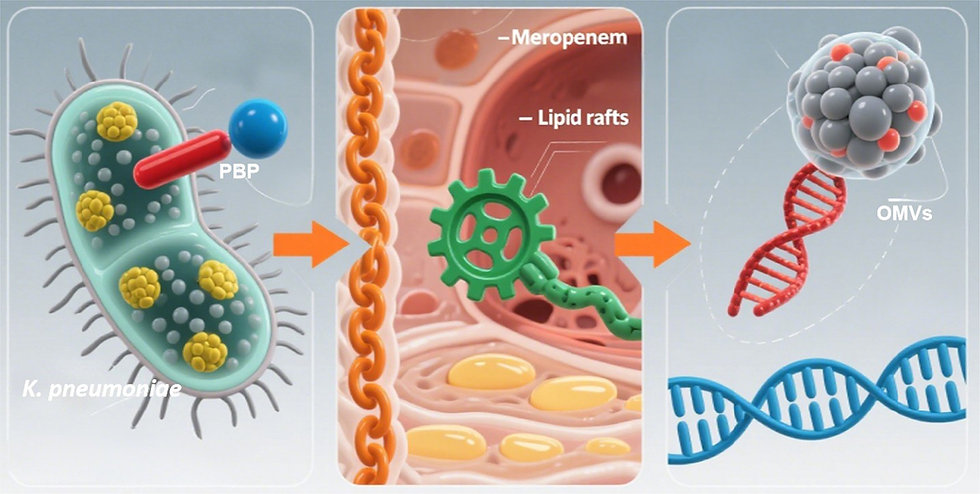
CRKP-derived outer membrane vesicles (OMVs) serve as multifunctional vectors for antibiotic resistance, encapsulating a diverse array of lipids and harboring the carbapenemase gene blaKPC.
Meropenem stress triggers a marked upregulation of membrane lipids in CRKP-OMVs, particularly sphingolipids (SP), glycerolipids (GL), glycerophospholipids (GP), and fatty acids (FA), which likely fortify bacterial antibiotic resistance through enhanced membrane stability and efflux efficiency.
CRKP-OMVs mediate horizontal gene transfer of blaKPC-2 to both intra- and interspecies susceptible bacteria, with meropenem-induced lipid remodeling significantly boosting transformation efficiency—a potential accelerator for environmental resistance spread.
Abstract
Carbapenem-resistant Klebsiella pneumoniae (CRKP) has emerged as a critical global health threat, fueled by escalating antibiotic resistance rates among clinical isolates. This study investigates the adaptive responses of CRKP to meropenem, a last-line β-lactam antibiotic, with a focus on the role of outer membrane vesicles (OMVs) in resistance evolution. Under meropenem stress, CRKP exhibited significant upregulation of total lipid content within OMVs (CRKP-OMVs), particularly enriched in glycerophospholipids and sphingolipids to enhance bacterial membrane integrity. Notably, CRKP-OMVs function as critical vehicles for the carbapenemase gene blaKPC-2, in addition, meropenem exposure significantly augments their horizontal gene transfer (HGT) efficiency. Compared to control OMVs, these drug-induced vesicles facilitated a 3.52-fold and 12.08-fold increase in blaKPC-2 dissemination into carbapenem-susceptible K. pneumoniae and E. coli recipients, respectively. Proteomic profiling revealed meropenem-driven upregulation of efflux machinery (e.g., PET family inner membrane protein YccS, multidrug resistance outer membrane channel MdtQ) and lipid transporters (LptB, LplT, phospholipid-lipopolysaccharide ABC transporter). These findings demonstrate that meropenem exposure modulates OMVs' proteolipid composition and enhances biofilm formation, while simultaneously promoting OMV-mediated dissemination of resistance genes through their function as mobile genetic vectors under therapeutic pressure, suggesting a potential defensive mechanism against antibiotic penetration.
Read full article for free (open access):


Comments